Showing posts with label HMS RESOLUTION. Show all posts

Monday, 4 January 2010

History of the British Nuclear Arsenal

Britain's Nuclear Weapons

History of the British Nuclear Arsenal

[...]

Polaris Warhead

There is some confusion about whether there were really two Polaris warheads (that is, "physics packages") or only one. The initial deployment of the three warhead A3T Polaris SLBM was accompanied by the production and deployment of a British-produced warhead, apparently a version of the American W-58 200 kt warhead deployed on the U.S. Polaris A3. Later an update of the Polaris missile force, known as the Chevaline program, was carried out with the modified missiles being re-designated the A3TK. This update included a new bus (upper stage), new RVs, and a sophisticated penetration aid (decoy) package. It is not completely clear whether the existing Polaris warheads were simply repackaged, or whether a completely new model was introduced. Due to Britain's limited weapons development and production capacity it seems likely that the warheads used to equip Chevaline, were based on the preexisting Polaris warheads.

Immediately after the 10 June 1963 decision by the British Admiralty to acquire the next-generation A3T Polaris SLBM (in preference to the A2 version then deployed by the U.S., Aldermaston began full-scale developmental work on the Polaris warhead. The design is said to be completed in the spring of 1966, with production beginning in 1966 or 1967. The "developmental" and "design" work associated with this warhead presumably involved adapting the already proof-tested American W-58 warhead to manufacture in a British plant. The warheads were deployed in Mk-2 RVs purchased from the U.S.

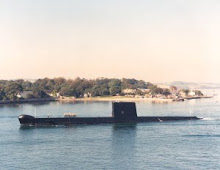
HMS Resolution
352x261, 20 K
HMS Resolution
The Polaris A3 was the first multiple warhead missile, equipped with three MRVs (multiple re-entry vehicles). The MRVs were dispersed around a central aiming point, they were not independently targeted. Four Polaris subs of the Resolution class were deployed, each with 16 missiles. It is believed that only 144 warheads (plus possibly some spares) were manufactured, enough to equip three subs at a time. The fourth boat was in port for maintenance and refitting at any given time.

Two mid-life update programs were instituted for the Polaris missile.

[...]

More here:

SEA YOUR HISTORY

Polaris firing

Resolution was also the first British submarine to fire a Polaris missile. This took place during a trial off Cape Kennedy in Florida on 15th February 1968. Chief Executive Hugh Mackenzie noted when the Polaris project launched that the first missile from a British submarine would fire at 11.15 Eastern Standard Time on 15th February 1968. Resolution was indeed ready by that date to fire the missile at the US Air Force Eastern Test Range. She only failed to meet the designated firing time by 15 milliseconds.

Missile compartment onboard HMS Resolution (RNSM)

Polaris patrol

The submarine's first Polaris patrol commenced in June 1968.

On going out on a patrol, a hunter/killer submarine or helicopter initially escorted the submarine in case she was being trailed by Soviet submarines. Once Resolution reached the open sea, she dived and headed for a secret patrol location known only by a handful of senior officers and the Prime Minister. The submarine could receive signals broadcast from its base in ultra low frequency waves using an aerial towed behind the boat.

Control room of HMS Resolution, 1976 (RNSM)

Resolution was fitted with a PWR1 nuclear reactor, which enabled the submarine to achieve a speed of 25 knots while submerged. However, since stealth was Resolution's prime consideration whilst on patrol, she was more likely to travel quietly at just a few knots as this created less disturbance below the waves.

Old picture records HMS Resolution

U.K. RESOLUTION Class Submarine - Polaris - The British Strategic Systems Programs

POLARIS

United States (U.S.) assistance and support to the United Kingdom’s (U.K.) strategic systems programs are covered by the POLARIS Sales Agreement, which was a direct result of the now-historic meeting at Nassau in December 1962 between President Kennedy and Prime Minister MacMillan. SSP has additional responsibilities related to the British Strategic Systems Programs.

Under the terms of the Sales Agreement, the U.S. sold POLARIS missiles (less warheads) to the U.K. In addition to the missiles, the subsystems that make up the weapon system were also sold. The British built their own nuclearpowered submarines to house the weapon system and provided their own warheads.


HMS RESOLUTION (Pingbosun: Nuclear Submarisnes of Today)


22nd May 1970: Crewmen at the controls of the HMS Resolution, a British nuclear submarine. (Photo by Wood/Express/Getty Images)

22nd May 1970: Members of the crew on the nuclear submarine HMS Resolution, looking at pictures of nude women whilst relaxing on their bunkbeds. (Photo by Express/Express/Getty Images)

23rd May 1970: Six Sea Cadets stand atop the Polaris submarine HMS Resolution while it docks in Portsmouth harbour. (Photo by Central Press/Getty Images)

http://www.shima.demon.co.uk/rboat.htm

Wednesday, 17 June 2009

HMS RESOLUTION

NOTE: I found the following material from MHSm RESOLUTION Association website and well remember many of the pictures appearing in the publicity material we used to hold onboard HMS RESOLUTION.
HMS Resolution (S22) was the first of the Royal Navy's Resolution-class ballistic missile submarines. Ordered in May 1963, she was built by Vickers Armstrong at a cost of £40.2m. To read more, click here.

FACTS and FIGURES
    Displacement: surfaced 7,500 tons; submerged 8,400 tons. Length:425 ft (130 m) Beam:33 ft (10 m) Draught:30 ft 1 in (9.2 m) Propulsion:1 × Vickers/Rolls-Royce PWR.1 pressurised-water nuclear reactor, 27,500 shp (20,500 kW); Propeller. Speed:surface - 20 kn (37 km/h); submerged - 25 kn (46 km/h) Range:Unlimited except by food supplies Complement:143 (two crews)

Polaris Submarines

The mid 1950s development of the submarine launched Polaris ballistic missile by Lockheed and the US Navy led, eventually, to the signing of the Polaris Sales Agreement between Prime Minister Harold Macmillan and President John F Kennedy.
Resolution
Resolution
It was decided that the United Kingdom would have four Polaris submarines to carry the latest A-3 missiles; that the submarines would be British designed and built; that the whole weapon systems and equipment, except warheads, would be purchased from the United States; and that the warheads would be British. The Government directive was explicit; the four SSBNs (Ship Submersible Ballistic Nuclear) were to be deployed at the earliest possible date and the programme executed within the allotted budget. 'A challenge had been issued and a challenge was going to be met'. To read more click here.
Repulse
Barrow's second Polaris Sub - Repulse
The planning and design effort which went into the Polaris submarine programme was colossal 500 000 man-hours of planning, preparation of more than 10 000 carefully detailed drawings all to be translated into the physical business of construction. To read more, click here.
Unit in shed
A Resolution unit under construction in the Assembly Shed

Resolution launch
Resolution launch
The autumn of 1967 was an important one in the history of Vickers. Resolution, having successfully completed her Contractors' Sea Trials, was accepted into the Fleet on 2nd October.
To provide an operational submarine of completely new design, with a complete weapon system from the United States and with adequate support facilities, within 4½ years of ordering the vessel, was a truly remarkable performance. 'Vickers' workforce had met their challenge!' To read more, click here.
Polaris Missle
The firing of HMS Resolution's second Polaris A-3 on April 3rd 1968
VIGILANCE MAINTAINED
Being the United Kingdom's contribution to NATOs strategic nuclear deterrent, at least one Polaris submarine was constantly on patrol, sailing submerged 'one knows not where', but always carrying her deadly 'cargo' of two-stage ballistic missiles. To read more, click here.


To read complete article, click on link http://www.hmsresolution.org.uk/about/about.htm
To read about Barrow-in-Furness Submarine Association, click here.